
Call Center Outsourced evidence brief · Desk review · Published
Warm Transfer Acceptance Evidence in Outsourced Call Centers
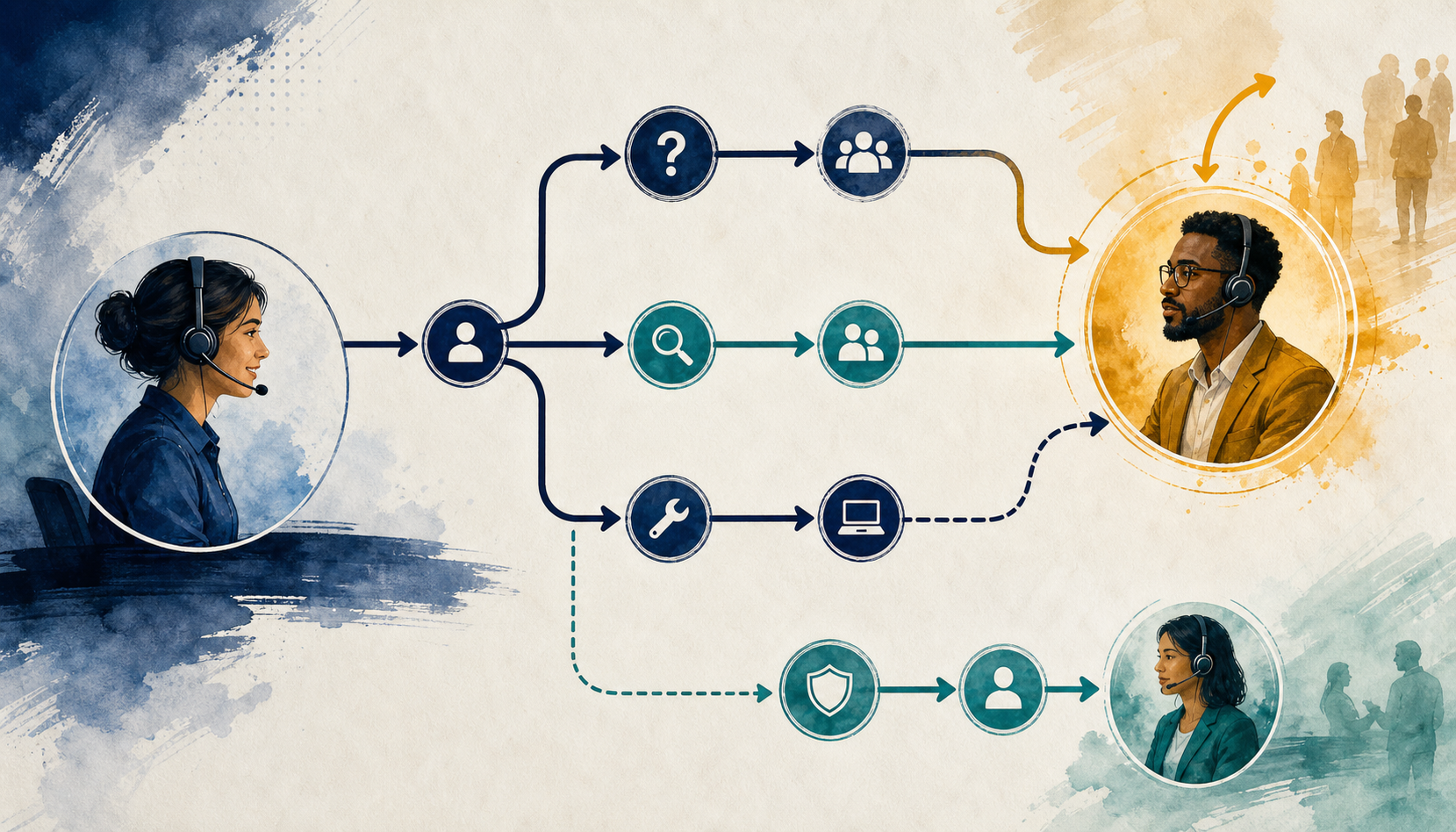
A transfer log can show movement without showing whether the receiving role understood and accepted the customer’s unresolved need.
Key stats
- 2 linked interaction records per sampled transfer
- 1 explicit receiving owner
- 4 transfer outcomes kept separate
Key takeaways
- Measure acceptance, not merely connection.
- Compare the spoken introduction with both queue records.
- Treat customer repetition and returned transfers as signals, not automatic proof of failure.
Research question
This desk-review method asks whether a warm transfer preserves enough decision context for the receiving role to continue safely. It focuses on live customer contacts that cross a skill, queue, vendor, or client boundary. The study does not assume that every transfer should be avoided or that every repeated question is unnecessary.
Evidence scope
ISO 18295-1 provides a customer-contact process and responsibility frame. NIST CSF 2.0 supports governance and accountable control design. The NIST Privacy Framework supports purpose-based handling and minimization. These sources justify examining ownership and information flow, but none defines a universal transfer-acceptance score or target.
Paired-record method
Select transfers from a fixed period and link the sending interaction, receiving interaction, transfer note, routing event, and eventual outcome. Define required context by contact reason: customer purpose, completed verification, action already taken, open decision, communication constraint, and next promise. Ask a reviewer to reconstruct the next action from the receiving record before showing the final outcome.
Outcome classes
Keep accepted and continued, accepted then returned, disconnected before acceptance, and connected without a traceable owner separate. Record customer repetition as required re-verification, new information, clarification, or preventable reconstruction. A long transfer note should not score well when the receiving person still cannot identify the unresolved question.
Interpretation limits
Routing logs may omit spoken acceptance, consult calls, screen context, or work completed outside the sampled systems. A customer may repeat details by choice. Privacy and identity rules can properly require a new check. The method can locate missing context and ownership, but it cannot assign intent or prove that a transfer caused the final customer outcome.
Operating use
Use the findings to define the smallest transfer note, the accepting role, the failed-transfer fallback, and the review sample. Keep policy, remedies, access, and sensitive account decisions with the authorized client owner.
Put this into a support lane
Define the sampled routes, required context, acceptance event, fallback, and client-owned decisions.
Plan a controlled transfer reviewRelated operating guides
FAQs
Is connection time enough to prove acceptance?
No. It shows that a routing event occurred, not that a receiving person accepted the unresolved work.
Should every repeated question count as failure?
No. Separate required verification and new customer information from repetition caused by missing context.