
Call Center Outsourced evidence brief · Desk review · Published
Failed Transfer Recovery in Outsourced Call Centers
A paired-record study can show whether dropped and rejected transfers regain an owner before the customer has to start again.
Key stats
- 1 fixed observation period
- 2 linked records reviewed
- 1 accountable owner at cutoff
Key takeaways
- Define the event before sampling.
- Preserve open work at the cutoff.
- Separate observed facts from management decisions.
Research question and scope
This study asks what happens after a live transfer disconnects, returns to the sender, or reaches a destination that does not accept the work. The unit of analysis is one customer need linked across the available contact and work records.
Source basis
ISO 18295-1 supplies customer-contact process context. NIST CSF 2.0 supports defined governance and ownership. The NIST Privacy Framework and Digital Identity Guidelines inform purpose, minimization, and identity boundaries. None of these sources sets a universal queue target or proves vendor performance.
Study method
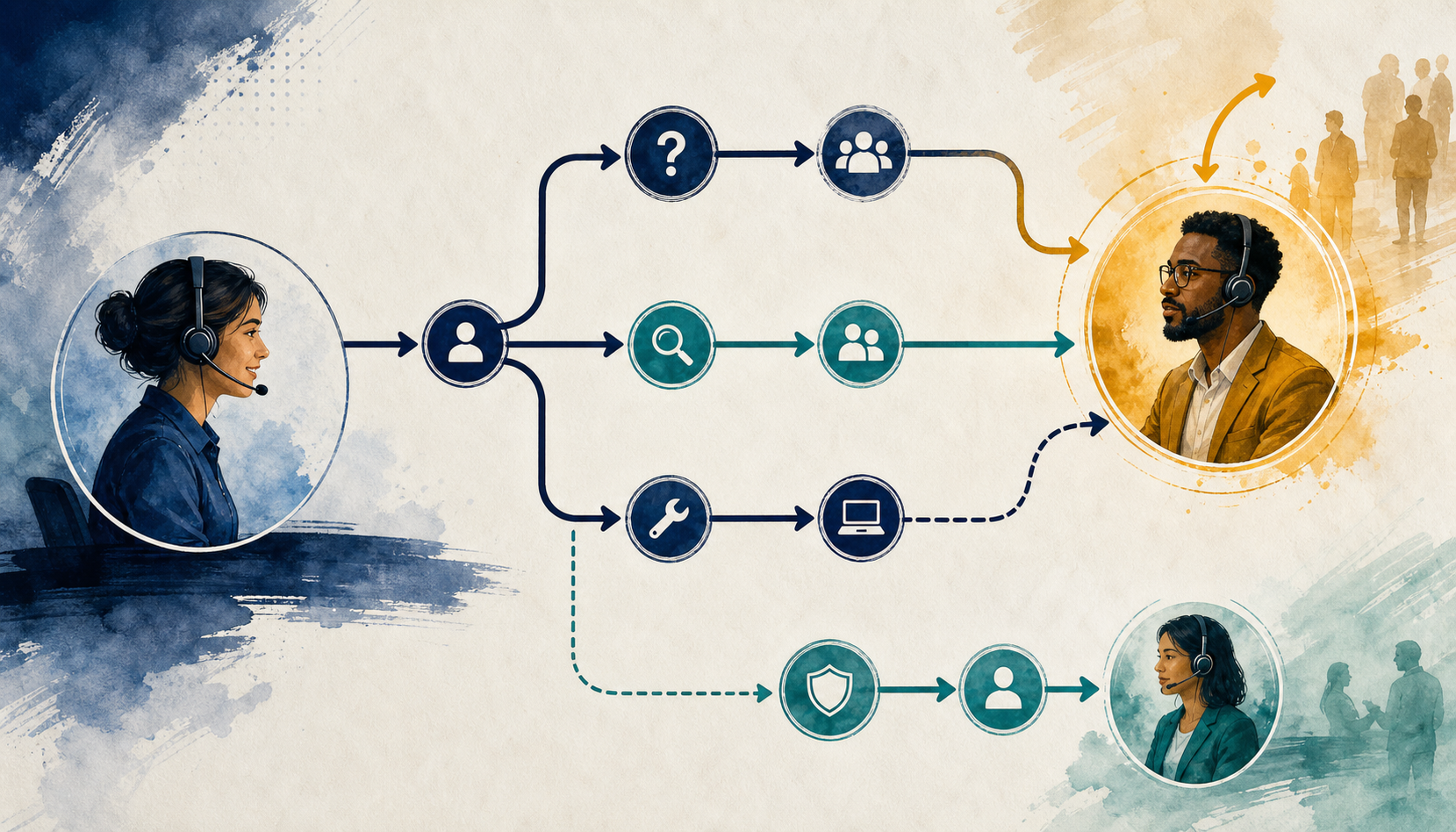
Select every failed transfer in a fixed period. Link the sending interaction, routing event, receiving record, recovery attempt, customer promise, and final status. Report time to accepted ownership separately from time to the next contact. Include records still open at the cutoff so the sample does not reward fast closure.
Interpretation limits
Telephony events may not capture a spoken acceptance, local outage, or work completed in another system. A later contact does not prove that the transfer caused the customer to call again. The work is a bounded operational review, not legal advice or a causal experiment.
Operating use
Managers can set a failed-transfer fallback, required handoff fields, and an acknowledgment clock. The method does not decide remedies or individual performance. Publish the definitions, exclusions, period, and missing-data rules beside any result.
Put this into a support lane
Choose one queue, define the cohort and cutoff, and name the decision owner before sampling.
Plan a bounded evidence reviewRelated operating guides
FAQs
Does this method set a universal benchmark?
No. Compare results only after the queue, event definitions, period, and exclusions are fixed.
Can the review prove why an error happened?
No. It can locate evidence gaps and patterns that an authorized owner should investigate.