
Call Center Outsourced evidence brief · Desk review · Published
Intent Drift Between IVR Selection and Inbound Agent Handoff
An IVR choice is routing evidence, not a verified customer need; research should test where labels, context, and authority diverge before the agent acts.
Key stats
- One defined operating cohort
- One authoritative state record
- Unknown and conflicting states reported separately
Key takeaways
- Measure the decision boundary, not activity alone.
- Keep source events separate from agent interpretation.
- Escalate exceptions to a named client owner before expanding the workflow.
Decision question and inbound boundary
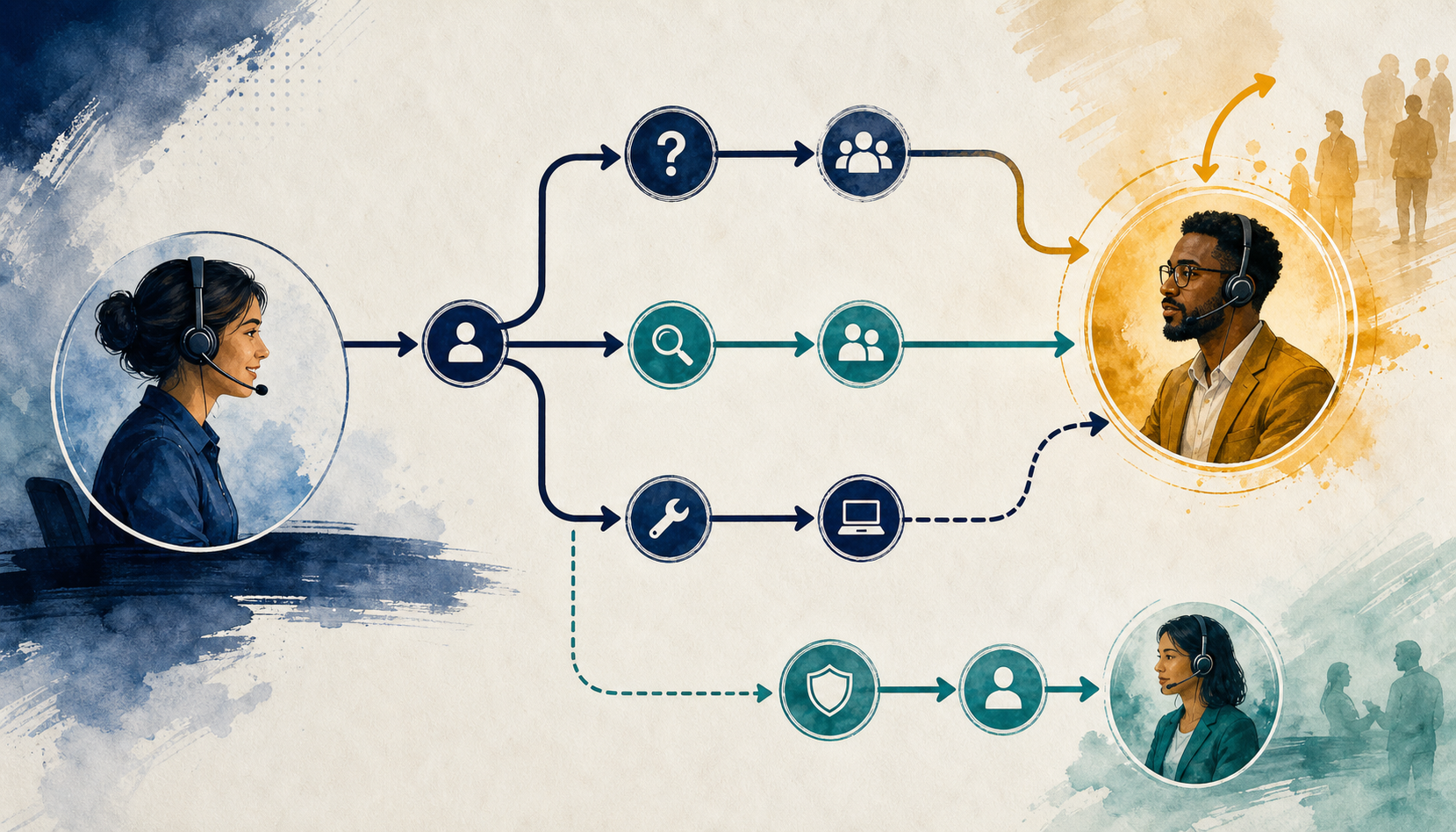
How often does the reason inferred from an interactive voice response selection still match the customer’s stated need when an outsourced inbound representative accepts the contact? The unit is one offered contact linked to the IVR path, menu version and language, key or speech input, routing label, transfer history, agent opening question, customer-stated purpose, identity state, permitted action, correction event, next owner, and disposition. The IVR selection can help place a contact, but it does not establish identity, urgency, entitlement, or consent. A caller may choose the nearest available label, misunderstand a translated prompt, reuse an old shortcut, or have several needs. The provider may confirm the purpose, correct an operational label, and route within written authority. It should not treat the menu choice as a customer admission, reveal account information because a sensitive queue was selected, or force the customer to restart simply because the initial route was wrong. The client owns menu design, authentication, priority rules, specialist access, emergency handling, and remedies when routing causes harm.
Primary-source basis and interpretation
ISO 18295-1 provides customer-contact service and performance context across inbound and outbound channels. The NIST Privacy Framework supports a defined purpose and proportionate handling of contact metadata. NIST Digital Identity Guidelines separate identity evidence from convenient signals, while Cybersecurity Framework 2.0 supports governed roles, observable events, response, and improvement. These sources support explicit definitions, minimal data use, attributable routing changes, and an owned exception path. They do not prove the customer’s intent, require one menu depth, select an authentication level, or establish that transfer avoidance is always desirable. A quick transfer can be the safe result when the first queue lacks authority. Analysis must therefore distinguish routing accuracy, customer effort, authority fit, and completed outcome instead of collapsing them into one containment rate.
Cohort method, counterexamples, and failure modes
Freeze the menu version and declare an observation window. Include answered, abandoned, transferred, misrouted, language-assisted, and unresolved contacts; do not sample only completed calls. Stratify by entry label, language, time band, transfer count, and customer impact. Have a second reviewer code the opening exchange without seeing the original route, then reconcile disagreements. Test a billing label used for an order-status question, a technical-support label chosen after an outage message, a caller with two needs, a speech-recognition fallback, a transferred caller whose original selection is lost, and an urgent statement that does not fit any menu. Compare routing logs, approved transcript or recording evidence, CRM reason, agent correction, accepting-owner acknowledgment, and final status. Report exact matches, partial matches, corrected labels, safe transfers, loops, disconnects, unknowns, and unresolved cases separately. Common failures include rewarding containment after the wrong action, counting an agent correction as caller error, exposing sensitive context in a transfer note, preserving stale intent across a second need, and redesigning a menu from a convenience sample. The result is observational; it can locate drift but cannot by itself prove whether wording, recognition, customer strategy, training, or queue design caused it.
Research method and evidence discipline
Define the decision, observation period, eligible population, operational unit, field dictionary, time-zone convention, exclusions, and reviewer instructions before extracting records. The unit may be a contact, case, order line, appointment slot, score appeal, or reminder attempt, but it should not change midway through analysis. Preserve ordinary, adverse, open, transferred, abandoned, corrected, duplicated, and unknown outcomes unless a documented rule excludes them. Use a census for a small population; otherwise stratify a sample across channels, shifts, contact reasons, risk classes, experience levels, and outcomes. A second reviewer should independently inspect a risk-weighted subset and record disagreements rather than forcing silent consensus. Separate the customer statement, source-system event, worker action, reviewer classification, and management inference. A timestamp shows that a system recorded an event; it does not by itself prove customer understanding, downstream acceptance, or causation. Report missing fields and conflicting systems as findings. Compare periods only when scope and definitions remain materially stable. If a correction is required, preserve the first issued result and document what changed.
Measures and management decision
Publish counts before percentages and pair an average or median with the oldest, slowest, highest-impact, and unknown cases. Useful fields include demand offered, handled, unresolved, transferred, reopened, corrected, awaiting client decision, lacking an owner, and outside approved scope. Measure the elapsed time between receipt, acknowledgment, next action, decision, customer update, and closure where those events exist. Do not reward speed when the action exceeded authority, weakened verification, concealed uncertainty, or created another promise. Predefine critical events that receive individual review regardless of the aggregate result. The decision owner should record a bounded outcome: continue as designed, revise a named control, narrow or pause the lane, or expand after specified evidence. Each corrective action needs an owner, due date, expected mechanism, possible adverse effect, rollback or pause condition, and review date. The result is evidence for a service decision, not a universal vendor score or a ranking of individual workers.
Implementation and review cadence
Translate the research decision into a short operating brief before assigning live work. Identify the customer purpose, included and excluded requests, approved systems, allowed fields, permitted actions, prohibited actions, verification or evidence prerequisite, customer-facing wording source, escalation trigger, receiving owner, acknowledgment target, fallback owner, quality sample, and pause authority. Practice an ordinary case and a boundary case. Confirm that the receiver can see and act on the handoff without asking frontline support to make the reserved decision. During a pilot, review early cases frequently enough to catch a design defect before it becomes routine; the appropriate cadence depends on volume and severity, not a fixed universal schedule. Keep training completion separate from demonstrated readiness. After launch, inspect exceptions, repeat contacts, missing acknowledgments, records altered outside the normal path, customer complaints, and access changes. A favorable average should not erase a severe event, while one unusual event should not be presented as proof of widespread failure without population evidence. Record the effective time of each control change and compare the next cohort under the revised design.
Limitations and bounded conclusion
The cited standards and public guidance describe governance, identity, privacy, security, customer-contact, commerce, or debt-collection considerations at a general level. They do not establish the correct script, staffing ratio, response time, legal basis, remedy, calendar rule, shipment status, payment status, or access decision for a particular company. Repository and system records can omit informal work, unrecorded customer effort, accessibility barriers, and actions in downstream tools. A short study can miss seasonality and rare severe events; a long study can combine periods whose routing, people, tools, scripts, permissions, or policies changed. Correlation between an operating condition and an outcome does not prove cause. The method therefore supports a narrow conclusion about whether the chosen workflow produced reviewable evidence and kept exceptions with an authorized owner during the observed period. It cannot certify a provider, predict every customer outcome, or replace legal, privacy, security, employment, commercial, or policy judgment. Retest after a material change and keep residual uncertainty visible.
Replication record and source notes
Retain the research question, scope, field dictionary, inclusion and exclusion rules, source titles, publishers, URLs, September 28, 2026 check date, extraction version, minimized case references, reviewer instructions, calculations, disagreement log, missing data, competing explanations, decision, and follow-up date. Record source access dates separately from the publication dates of source documents. Link each source to the claim it supports and label operational recommendations as analysis or inference when they are not quoted requirements. Preserve effective times for changes to staffing, tools, routing, scripts, permissions, knowledge, client policy, and service objectives. Another reviewer should be able to recreate the eligible cohort and understand why a case was classified without receiving unnecessary customer content. When guidance changes, preserve the prior study and issue a truthful modification record rather than backdating the original. This creates a durable trail while keeping customer data and final business decisions in their authorized systems.
Put this into a support lane
Choose one queue, document permitted actions and exceptions, and test the handoff before adding volume.
Map a controlled support laneRelated operating guides
FAQs
Does this research make a legal, security, or compliance determination?
No. It is an operational research method. Authorized legal, privacy, security, commercial, and policy owners must apply requirements to the actual service, data, contract, and jurisdiction.
Does this brief prescribe one universal target?
No. A useful threshold depends on the customer journey, risk, source quality, channel, authority boundary, and client decision owner.