
Call Center Outsourced evidence brief · Desk review · Published
Call Center Escalation-Path Design: A Research Brief
An escalation path is a decision system, not a list of names: it must show authority, evidence, acknowledgment, fallback, and customer impact.
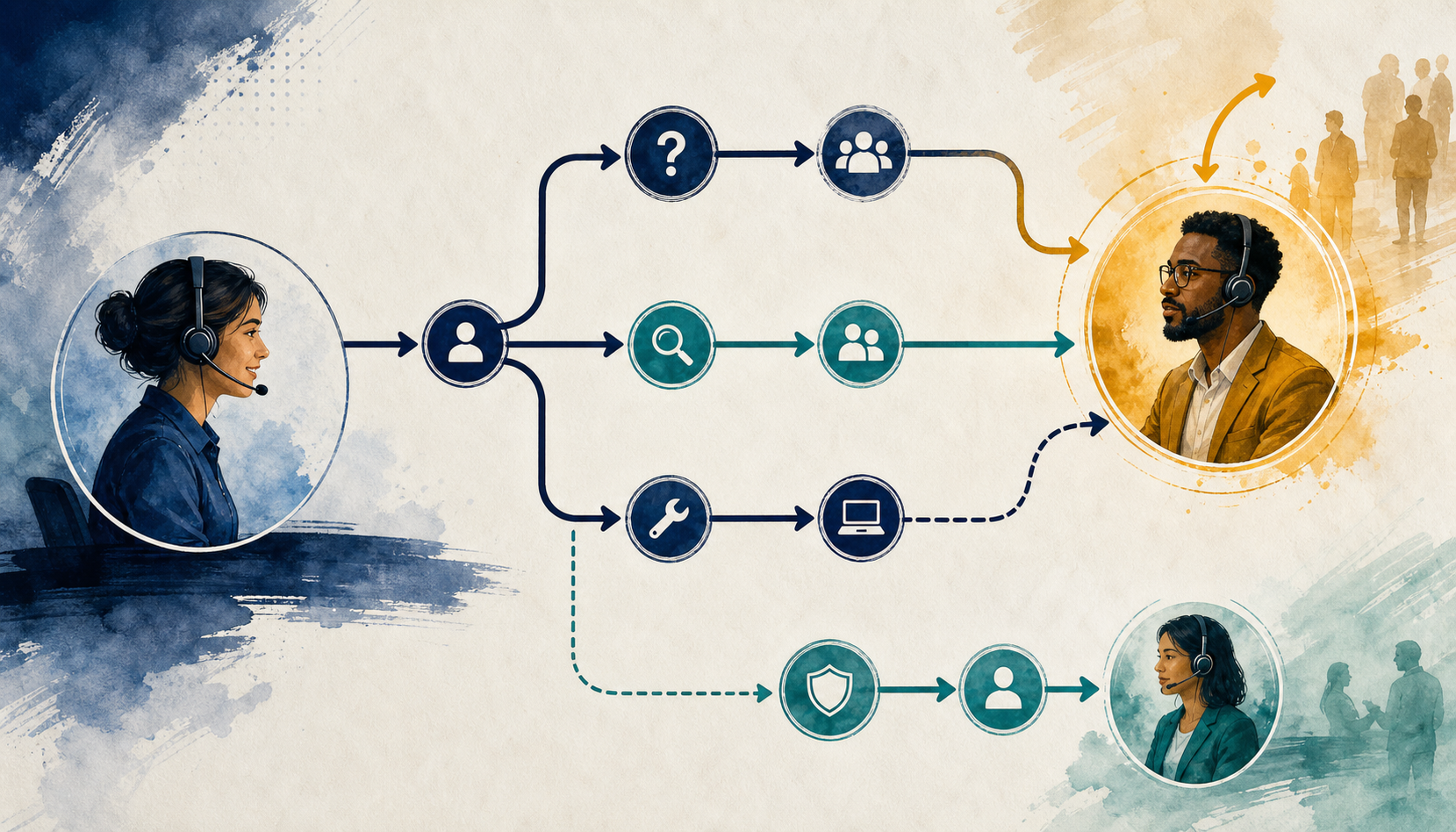
Research question
How can a customer-contact operation tell whether an escalation path is usable before a high-impact case is waiting inside it? Many teams possess an org chart and still cannot answer who may decide, who must acknowledge, or what happens when the named owner is unavailable. This research focuses on outsourced call-center queues handling exceptions, complaints, account concerns, service interruptions, and promises that exceed frontline authority. It studies the path as a chain from intake to decision and customer update. It does not prescribe a staffing ratio, a severity scale, or a client’s remedy policy. Those are decisions for the business owner. Escalation maps also need a change-control trail. A route that was valid during one client process may become wrong after a system migration, policy revision, leave period, or new service scope. Record the effective date, impacted queues, temporary fallback, and the person who accepted the change. Review returned cases for evidence that the map itself was stale rather than assuming the worker chose badly. A route should state what happens when the required evidence is unavailable: narrow the response, pause the action, seek an approved source, or notify a named owner. Those are different outcomes and should not be hidden inside a generic pending status. Managers can use a short route rehearsal before expanding volume, while the client owner retains the decision about policy and remedy. The research value lies in making the path reproducible under ordinary pressure, including the pressure created by an unavailable owner. Any review should state the observation window, unit of analysis, missing fields, and owner of the next decision. Facts should remain separate from recommendations, and unknown outcomes should remain unknown rather than being treated as successful completion. The support role can preserve evidence and apply an approved route; it cannot create a client policy from a pattern in the sample. This boundary keeps the research useful for managers while avoiding unsupported claims about a particular team, result, location, or credential. The route study should cite ISO 18295-1 (https://www.iso.org/standard/73338.html), NIST Cybersecurity Framework 2.0 (https://www.nist.gov/cyberframework), and NIST incident-handling guidance (https://csrc.nist.gov/pubs/sp/800/61/r2/final) as distinct evidence sources. Start with a fixed-period inventory of escalation events and a separate tabletop sample. For every case, record the trigger, evidence attached, receiving role, authority available, acknowledgment event, customer update, fallback, return reason, and closure evidence. Ask a second reviewer to route the same scenarios using only the recorded map; disagreement is a finding about route clarity, not automatically a worker failure. Separate facts such as an unacknowledged handoff from analysis about capacity, severity, or stale ownership. Include a route whose named owner is unavailable and a case whose impact changes after intake. This makes the method sensitive to the conditions that turn an org chart into an unowned queue. The cited incident guidance is a preparedness and response reference, not a customer-service severity taxonomy, and none of the sources selects a client remedy, staffing ratio, or legal decision.
Evidence frame
ISO 18295-1 supports explicit contact processes, workforce responsibilities, and review of customer results. NIST CSF 2.0 frames governance and response as owned activities rather than informal heroics. NIST incident-handling guidance adds preparation, detection, analysis, containment, recovery, and lessons learned for incidents, while not turning every complaint into a security incident. Taken together, the sources support asking whether a route has scope, evidence, authority, timing, acknowledgment, and recovery. They do not establish the correct path for every company. Legal interpretation, credits, refunds, account changes, and safety decisions remain with authorized client owners.
Method
Map one queue’s escalation routes using records from a fixed period. For each route, capture trigger, required evidence, receiving role, allowed decision, acknowledgment expectation, customer promise, backup, return condition, and closure evidence. Then test the map with tabletop cases that include a routine exception, a missing source, a conflicted instruction, an absent owner, and a case whose severity changes after intake. Review actual escalations separately from drills. Have a second reviewer attempt to route each case without relying on personal knowledge. Record where the map is ambiguous, where access blocks the receiving role, and where the fallback is only a phone number with no durable record.
Findings to separate
A route can fail because the frontline worker lacked evidence, the receiving owner lacked authority, the queue used the wrong severity, the acknowledgment clock was undefined, or the case returned without a reason. These are different facts and should not collapse into “agent escalation error.” Analysis may suggest a form field, a routing rule, a backup owner, or a narrower service scope, but the remedy should follow the observed mechanism. A route that accepts every case may look responsive while creating an unowned downstream backlog. A route that rejects almost every case may protect capacity while hiding customer harm. Both need outcome evidence, not just transfer counts.
Route-specific methodology and evidence
The study uses ISO 18295-1 at https://www.iso.org/standard/73338.html, NIST Cybersecurity Framework 2.0 at https://www.nist.gov/cyberframework, and NIST incident-handling guidance at https://csrc.nist.gov/pubs/sp/800/61/r2/final. Start with a fixed-period inventory of live escalations and a separate tabletop sample. For each case record the trigger, evidence attached, receiving role, authority available, acknowledgment, customer update, fallback, return reason, and closure evidence. Ask a second reviewer to route the same scenarios using only the map that existed at that time. Include an unavailable owner and a case whose impact changes after intake. An unacknowledged handoff is a fact; conclusions about capacity, severity, or stale ownership are analysis and should be tested against the record. Incident guidance informs preparedness and response, not a universal customer-service severity taxonomy, staffing ratio, or client remedy.
Operating roles
The frontline role identifies the request, uses approved evidence, states only the promise it is authorized to make, and sends a complete bounded handoff. A supervisor owns immediate triage, coaching against an approved rule, and backup notification. The client owner decides policy, remedy, scope, and exceptions that require business authority. A service coordinator maintains the route map and effective dates but cannot silently change decision rights. This division matters for CallCenterOutsourced.com: outsourced support can make the path observable and reliable without pretending to own the customer policy behind it.
Scenario and measures
Suppose a customer disputes a charge and also reports that a promised service window was missed. The frontline worker sends the case to a billing route that has authority over the charge but no owner for the missed promise. The customer receives two partial updates and repeats the story. Research should measure acknowledgment by route, return reasons, handoff completeness, customer-update misses, time to decision, and cases with no backup. Segment by impact and dependency. Do not reward a low transfer rate if unresolved exceptions remain in the original queue. Preserve the route version used at the time so later map changes do not rewrite history.
Limits and conclusion
Tabletop success does not prove live availability, and a short observation window can miss leave periods, outages, or seasonal demand. Incident guidance is not a customer-service severity taxonomy, and ISO does not provide an escalation matrix. The evidence-led conclusion is that a path is dependable when a worker can identify the trigger, attach sufficient evidence, reach an authorized owner, receive acknowledgment, and activate a fallback without losing the customer promise. Escalation design should make authority visible and uncertainty actionable; it should not turn transfer volume into a performance claim.